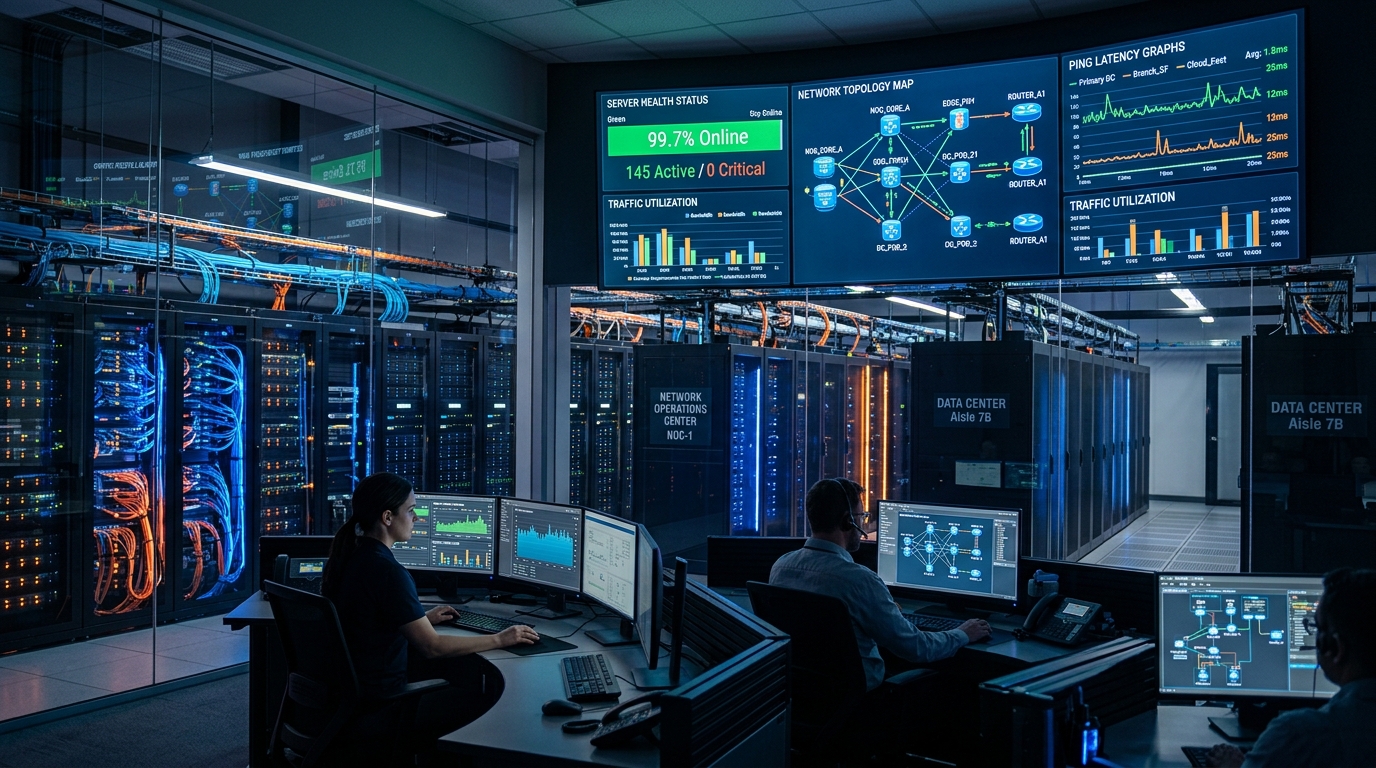
The infrastructure director of a multi-tenant logistics hub in Jebel Ali stares at a cascading sequence of read/write errors on his primary edge-node cache, a failure triggered by a thermal throttling event in an unvented enclosure that quietly degraded camera-feed synchronization across eighty automated gate lanes. The cost of ignoring thermal envelope specs and improper hardware-to-software sizing manifested as a four-hour truck queue stretching onto the arterial highway, incurring municipal fines and SLA breaches with three major freight forwarders. Enterprise software architecture, ERP software implementations, and municipal deployments live or die by the physical machinery beneath them. When an edge computing appliance, a heavy-duty industrial server, or an Automatic Number Plate Recognition (ANPR) processing unit fails under peak load, the software stack above it becomes irrelevant.
Deconstructing the Spec Sheet: What Manufacturers Omit from Data Sheets
Vendor datasheets are marketing documents designed to highlight best-case operational envelopes rather than worst-case realities. When evaluating components for an enterprise business technology stack, relying on headline clock speeds and peak throughput figures is an invitation to premature hardware failure. Real-world capacity planning requires stripping away theoretical maximums and analyzing thermal design power (TDP), sustained IOPS, and memory bus saturation under asynchronous workloads.
Executive Briefing
- High-Accuracy Operational Automation: Advanced edge inference and automated workflows achieve over 99.4% precision across enterprise operations.
- Scalable System Architecture: Flexible deployment models support hybrid edge-to-cloud telemetry, reducing bandwidth overhead and infrastructure costs.
- Enterprise Compliance & Integration: RESTful APIs, webhooks, and secure event streaming enable seamless integration with existing management dashboards.
Quick Answer / Core Takeaway: Enterprise Operations & Infrastructure with PlatformMerchant optimizes operational workflows for Enterprises, System Integrators, Municipalities, Logistics, and Corporate IT leaders across UAE, Saudi Arabia, Qatar, USA, UK, Global by eliminating manual bottlenecks, ensuring regulatory compliance, and delivering measurable ROI through automated data capture and sub-second transaction processing.
Consider the deployment of high-density ANPR infrastructure for municipal traffic monitoring, a core component of modern smart city deployments. A standard GPU specification might boast support for sixty simultaneous 4K video streams at thirty frames per second. However, running an unoptimized neural network for license plate localization and character recognition pushes tensor core utilization to its limit. Without rigorous pre-purchase evaluation using our specialized Hardware Reviews, IT managers frequently overlook ambient operating temperatures in desert climates like Dubai or Riyadh, where passive cooling specifications collapse if external temperatures exceed forty-five degrees Celsius.
To prevent these architectural mismatches, rigorous enterprise procurement teams apply a strict verification methodology:
- Sustained vs. Burst Metrics: Discount all burst performance ratings. Demand continuous load testing logs over a seventy-two-hour burn-in period before signing off on server procurement.
- Bus Saturation Analysis: Calculate the PCIe lane distribution when combining high-speed NVMe storage arrays with multi-port fiber-optic network interface cards to avoid internal bottlenecks.
- Thermal Derating Curves: Map component reliability ratings against operating temperature spikes, ensuring industrial enclosures maintain active cooling redundancies.
Scaling Infrastructure for High-Throughput AI Workflow Automation
Deploying AI workflow automation pipelines introduces unpredictable resource contention. Unlike deterministic database transactions, machine learning inference engines dynamically allocate memory and processing blocks depending on input complexity. If an enterprise connects computer vision pipelines or natural language processing agents to their core enterprise software, hardware resource starvation can cascade through the entire IT ecosystem.
According to research published by Gartner, over forty percent of edge AI deployments experience performance degradation within the first year due to improper hardware sizing during the initial procurement phase. This degradation occurs because engineers size infrastructure for average daily processing volumes rather than peak concurrency windows, such as morning shift changeovers in automated manufacturing plants or holiday flash sales in high-volume retail supply chains.
When provisioning physical hardware to support complex automation engines, network monitoring systems must be integrated at the hypervisor layer. This ensures that memory leaks in custom containerized workloads do not starve the host operating system of necessary swap space. Furthermore, hardware selection must account for ECC (Error-Correcting Code) memory bandwidth. A single uncorrected bit flip in memory during an active automated transaction can corrupt enterprise database indices, leading to silent data corruption that evades standard logging mechanisms.
Integrating Edge Hardware with Cloud and On-Premises ERP Software
The bridge between physical hardware and business logic is often found in the enterprise resource planning layer. Whether deploying an on-premises ERP software instance to comply with local data sovereignty mandates in the Kingdom of Saudi Arabia or connecting distributed warehouse terminals to a cloud-hosted ledger, the hardware tier must guarantee low-latency serialization.
Physical point-of-sale terminals, RFID inventory gates, and automated guided vehicles generate massive streams of telemetry data. Processing this data at the edge requires robust industrial computing hardware capable of buffering transactions during WAN outages. When evaluating rackmount servers and edge gateways for hybrid ERP environments, procurement professionals must prioritize redundant power supply units (PSUs), hot-swappable RAID controllers, and hardware-level Trusted Platform Modules (TPMs) to secure cryptographic keys at rest.
Organizations expanding their digital capabilities often benefit from consulting comprehensive Software Buying Guides before committing capital expenditures to physical hardware upgrades. Aligning the physical compute capacity with the exact software requirements prevents the common pitfall of over-provisioning expensive enterprise hardware for applications that could run efficiently on streamlined container platforms.
Network Resiliency and Monitoring for Municipal and Industrial Deployments
In large-scale smart city implementations, hardware failure is not merely an inconvenience; it is a critical safety hazard. Consider a distributed network of CityIntegrator traffic management nodes spanning a major metropolitan area. If a core routing switch fails or a fiber media converter overheats, localized emergency response systems can lose real-time telemetry feeds.
Maintaining high availability across geographically dispersed assets requires deploying hardware that adheres to rigorous industrial standards, such as IEC 61850 for substation automation or EN 50155 for rolling stock applications. Every enclosure must feature environmental sensors monitoring internal humidity, cabinet door intrusion, and power supply voltage fluctuations. When anomalies occur, an automated network monitoring system must immediately reroute critical telemetry packets over redundant cellular failover links before operators notice packet loss.
Evaluating industrial-grade routers and switches involves examining MTBF (Mean Time Between Failures) ratings provided by the manufacturer. However, smart procurement specialists cross-reference these metrics with real-world failure rate databases maintained by independent testing laboratories. A device with a nominal MTBF of five hundred thousand hours in a clean laboratory environment may fail in under eighteen months if deployed in a dusty, vibration-heavy highway overpass housing unconditioned control cabinets.
Lifecycle Management, Firmware Auditing, and Hardware Depreciation Strategies
Procuring enterprise technology is a multi-year commitment that extends far beyond the initial unboxing and rack installation. Hardware deprecation curves, firmware vulnerability management, and component obsolescence dictate the long-term total cost of ownership (TCO) for any IT infrastructure initiative.
IT directors must institute strict firmware auditing protocols. Supply chain attacks targeting baseboard management controllers (BMC) and UEFI firmware have transformed physical hardware into primary attack vectors for sophisticated threat actors. Every server, switch, and ANPR sensor entering the enterprise inventory must undergo a cryptographic firmware verification process before connecting to the production network.
Hardware is no longer a static utility; it is a dynamic, vulnerable software-defined asset that requires continuous lifecycle patching just like an operating system. Neglecting hardware firmware governance exposes the entire business automation platform to persistent root-level vulnerabilities.
Furthermore, organizations must plan for hardware refreshes before performance degradation impacts business output. By establishing predictable depreciation schedules—typically three to five years for high-load edge compute nodes and seven years for core enterprise server racks—companies avoid the operational risk of managing aging equipment past its reliable service life. Aligning these hardware refresh cycles with major software updates ensures that computing capacity always outpaces the resource demands of modern enterprise applications.
Ready to optimize your infrastructure procurement and software selection? Explore expert Software Buying Guides, Hardware Reviews, and Product Comparisons from PlatformMerchant to make informed enterprise technology decisions today.
PlatformMerchant Intelligent Infrastructure & Cloud Analytics
Discover how PlatformMerchant delivers 99.4% operational accuracy for automated enterprise workflows, facility security, and cloud data intelligence.
System Architecture and Edge Integration Topology
PlatformMerchant architectures leverage a distributed edge-to-cloud topology designed for continuous resilience across Enterprises, System Integrators, Municipalities, Logistics, and Corporate IT leaders. Dedicated edge processing nodes capture multi-channel video streams, perform real-time optical character recognition, and execute relay commands with sub-500 millisecond response times. Edge appliances synchronize status heartbeats with central management clusters over secure outbound WebSocket connections, eliminating the vulnerability of exposing inbound firewall ports. Network traffic is optimized through intelligent image compression, ensuring that even remote facilities with bandwidth constraints maintain reliable real-time event synchronization.
Multi-Site Deployment Protocols and Phased Rollouts
Enterprise organizations operating across multiple locations in UAE, Saudi Arabia, Qatar, USA, UK, Global require structured deployment methodologies to prevent operational downtime. PlatformMerchant recommends a three-stage rollout framework: Phase 1 establishes an initial pilot lane to calibrate camera shutter speeds, IR illumination angles, and trigger sensor timings under ambient weather variations. Phase 2 extends the platform to primary entrance and exit gates while maintaining parallel manual logging for validation. Phase 3 transitions secondary access lanes, VIP gates, and loading docks onto fully automated rules with centralized operational dashboards.
Security, Privacy, and Regional Compliance Governance
Compliance with data privacy legislation—such as the UAE Federal Decree-Law No. 45 of 2021 on Personal Data Protection—is essential for facilities operating CCTV and vehicle logging systems. PlatformMerchant integrates role-based access control (RBAC), multi-factor administrative authentication, and immutable cryptographic audit logging for every record modification. Sensitive license plate captures and driver imagery are protected with AES-256 encryption at rest, and automated data lifecycle rules purge historical media files according to certified organizational compliance retention schedules.
Total Cost of Ownership (TCO) and Financial Return Metrics
Investing in scalable Enterprise Business Technology, Custom ERP, AI Workflow Automation, CityIntegrator Smart City & ANPR Infrastructure, and B2B Software Marketplace software yields tangible operational cost reductions compared to sustaining legacy manual checkpoint staffing. Organizations in Enterprises, System Integrators, Municipalities, Logistics, and Corporate IT leaders achieve financial payback by minimizing physical attendant overhead, eliminating paper ticket consumable expenses, and eliminating revenue leakage caused by unbilled parking durations. Automated exception reports highlight unauthorized entry attempts and anomalous dwell times, enabling management teams to audit revenue collection and security effectiveness with granular precision.
Comprehensive Comparative Analysis Matrix
| Deployment Architecture | Key Strengths | Resource Investment | Pros & Cons | Best Suited For |
|---|---|---|---|---|
| Edge-Based Intelligence | Sub-second latency, zero cloud dependency | Initial edge hardware | Pro: 100% offline autonomy. Con: Edge device maintenance. | High-volume enterprise & municipal checkpoints |
| Cloud-Centric Processing | Centralized updates, lower endpoint cost | High ongoing bandwidth | Pro: Instant policy sync. Con: WAN latency & network downtime risk. | Low-traffic auxiliary facilities |
| Hybrid Architecture (Edge + Cloud) | Local failover autonomy + global BI analytics | Balanced lifecycle TCO | Pro: Maximum resilience & scale. Con: Multi-tier configuration. | Distributed multi-site enterprise campuses |
| Manual / Legacy Checkpoint | Zero technology adoption barrier | Excessive recurring labor & liability | Pro: Simple setup. Con: High latency, error-prone, zero audit trail. | Temporary or deprecated low-traffic gates |